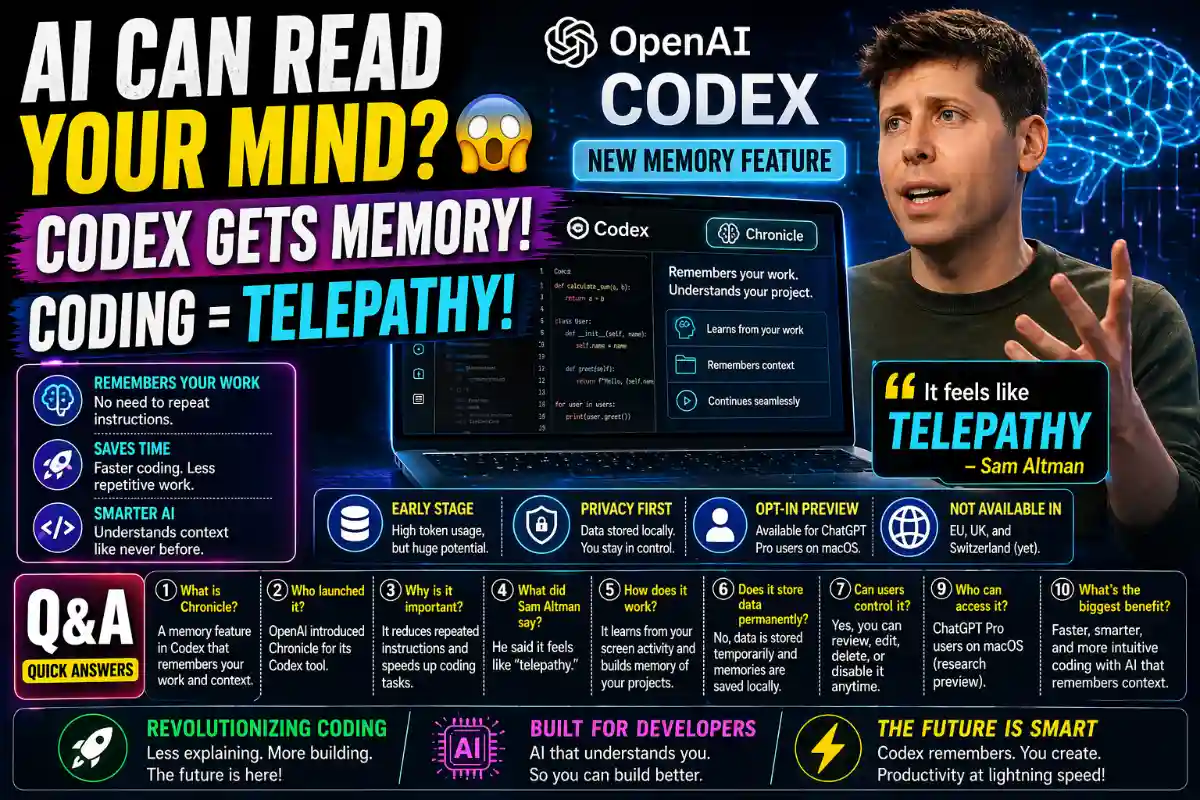
In a major leap for AI-powered coding, OpenAI has introduced a powerful new feature to its coding tool Codex—and it could completely change how developers work.
The company has launched a feature called Chronicle, which allows Codex to remember your work and understand your projects over time. And according to CEO Sam Altman, the experience is so smooth that it “feels like telepathy.”
Codex Now Remembers Your Work
With the new Chronicle feature, Codex can build memory based on what you do while working. This means the AI doesn’t need repeated instructions or long explanations every time.
Instead, it learns from your previous tasks and automatically understands context. For example, if you’re working on a project today, you can return the next day and simply give a short command—Codex will continue from where you left off without needing detailed prompts.
No More Long Prompts Needed
One of the biggest advantages of this update is that users no longer have to spend time writing detailed prompts.
OpenAI says Codex can now “fill in the gaps” by using stored memory. This makes coding faster and reduces repetitive work significantly. The goal is simple: make AI smarter so users can focus on building, not explaining.
‘Feels Like Telepathy,’ Says Sam Altman
Sam Altman described the experience as incredibly intuitive. He revealed that the internal name for this feature was actually “telepathy,” highlighting how naturally the AI responds to user needs.
Even developers at OpenAI say the feature has already changed how they use Codex in their daily work.
Early Stage, But Powerful
While Chronicle is still in an early phase, it already shows huge potential. However, it currently consumes a high number of tokens, which means it may require more computing resources.
Despite this, experts believe it could redefine how programmers interact with AI tools.
What About Privacy?
Since the feature works by observing your screen activity, privacy is a key concern.
OpenAI has clarified that:
- Screen data is stored temporarily on the device
- Memories are also stored locally
- Users can review, edit, or delete memories anytime
- The feature can be turned off whenever needed
This ensures users remain in control of their data.
Who Can Use This Feature?
Currently, Chronicle is available as an opt-in research preview for ChatGPT Pro users on macOS.
However, it is not yet available in regions like the EU, UK, and Switzerland. Users need to enable it manually and grant permissions like screen recording for it to work properly.
Q&A: Everything About Codex’s New Memory Feature
Q1. What is Chronicle?
It is a new memory feature in Codex that helps AI remember your work and context.
Q2. Which company launched it?
OpenAI introduced this feature for its Codex tool.
Q3. Why is it important?
It reduces the need for repeated instructions and speeds up coding tasks.
Q4. What did Sam Altman say about it?
He said using it feels like “telepathy.”
Q5. How does it work?
It learns from your screen activity and builds memory of your projects.
Q6. Does it store data permanently?
No, screen data is stored temporarily and memories are saved locally.
Q7. Can users control this feature?
Yes, users can edit, delete, or disable it anytime.
Q8. Who can access it right now?
ChatGPT Pro users on macOS (research preview).
Q9. Is it available worldwide?
No, it is currently not available in the EU, UK, and Switzerland.
Q10. What’s the biggest benefit?
It makes coding faster, smarter, and more intuitive by remembering context.